31 Profitable Business Models on Xiaohongshu and How to Grow Each One | manman
Essay ・ No. 05
31 Profitable Business Models on Xiaohongshu and How to Grow Each One
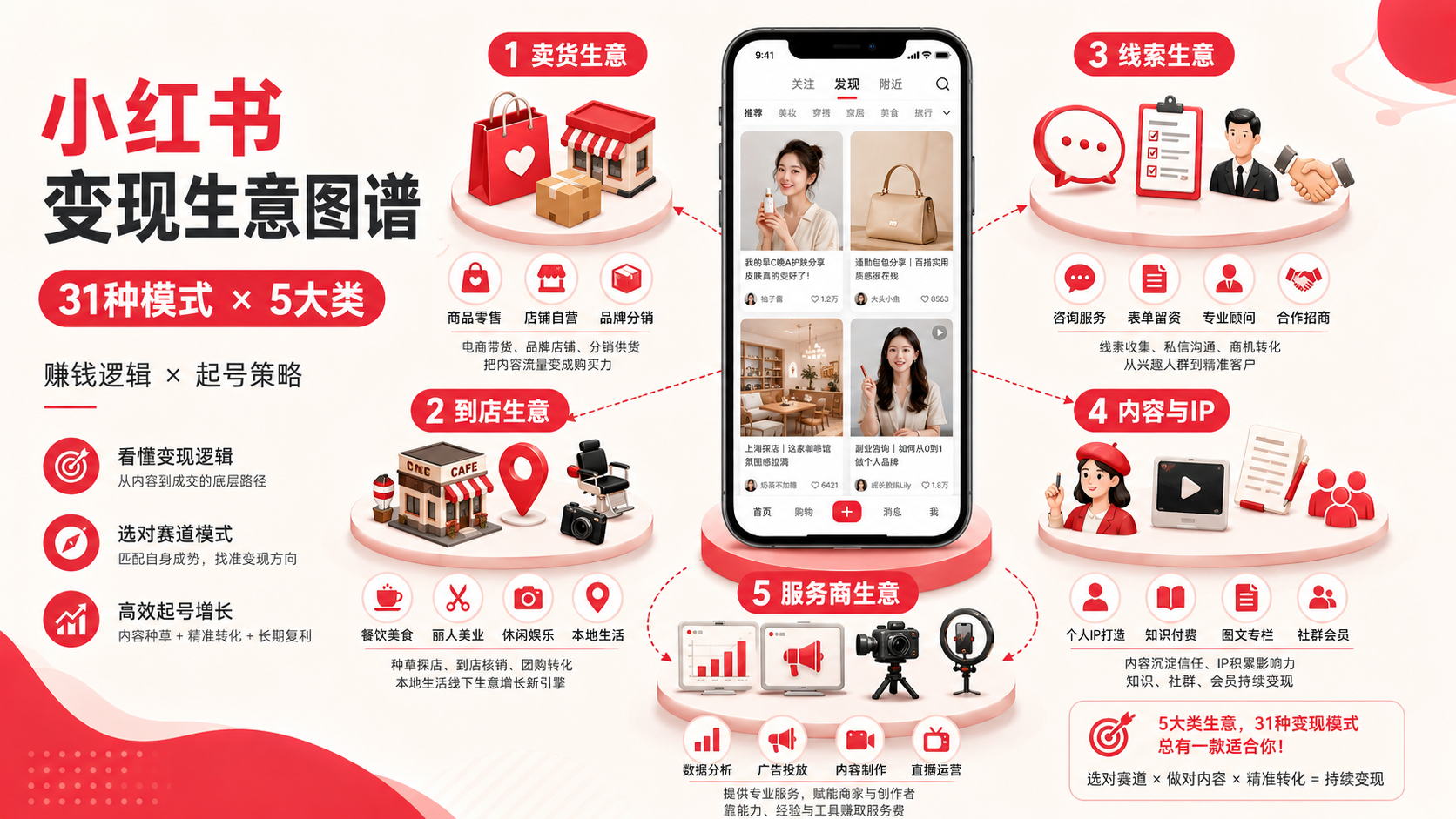
A practical breakdown of five major Xiaohongshu monetization categories, including e-commerce, local business, lead generation, content IP, and service provider models.
Xiaohongshu is not just a content platform.
It is also a search engine, a discovery channel, a trust-building layer, and a conversion path.
For brands, local stores, creators, consultants, and service providers, Xiaohongshu can become a serious business acquisition channel.
But before posting content, you need to understand what type of business you are building.
Most Xiaohongshu businesses fall into five categories:
Product-selling businesses
Local businesses
Lead generation businesses
Content and IP businesses
Service provider businesses
Each model has a different monetization logic.
Each one also needs a different account growth strategy.
1. Product-Selling Businesses
Product-selling businesses use content to move users from interest to purchase.
This model works well for brands, merchants, creators with products, and affiliates who can earn commissions through recommendations.
1. Xiaohongshu Store Sales
A Xiaohongshu store allows merchants to sell directly inside the platform.
Users can discover a product through a post, visit the store page, and complete the purchase without leaving Xiaohongshu.
This model works for brand owners, founder-led brands, and individual sellers with stable supply.
The revenue comes from product margins after users place orders.
A strong starting strategy is to avoid listing too many products at once.
Start with 1 to 3 core products.
Then create content around a specific target customer and use searchable titles.
For example:
High-waisted work pants for pear-shaped bodies
Spring jackets for petite women
Long-lasting foundation for oily skin
The goal is not to wait for random traffic.
The goal is to be discovered by users who already have clear purchase intent.
2. Buyer-Led Affiliate Sales
Buyer-led affiliate sales do not require your own inventory or store.
You recommend products through reviews, comparisons, and lifestyle content.
When users buy through your links, you earn a commission.
The key is not simply recommending random products.
The key is giving users a reason to trust your taste.
Start with a clear product direction, such as:
Skincare for sensitive skin
Outfits for petite women
Kitchen tools
Work bags
Products for new parents
The account should feel like a trusted curator.
If your positioning is unclear, users will not know why they should follow your recommendations.
3. Founder-Led Brands
A founder-led brand sells more than a product.
It sells the founder’s taste, story, lifestyle, and values.
This model usually supports higher pricing because users are not only buying features.
They are buying into a point of view.
The founder should become the center of the content.
Instead of only posting product images and specifications, create content around:
Why the product was created
The design inspiration
Material selection
Sampling and production
How the founder personally uses the product
Who the product is for
The biggest mistake is hiding the founder behind the brand.
If the account only posts product displays, it becomes no different from a normal store.
4. Factory and Supply Chain Sellers
Factory sellers and supply chain merchants can use Xiaohongshu to reach consumers directly.
This works especially well for sellers with strong sourcing advantages.
The content strategy should focus on origin and transparency.
Users need to feel that you are not reselling someone else’s product.
They need to see that you are close to the source.
Good content topics include:
Factory production lines
Raw materials
Sampling process
Cost comparisons
Same-product quality differences
Factory daily operations
The comment section is a strong source of content ideas.
The questions users ask most often are usually the objections you need to answer before they buy.
5. Open-Loop E-Commerce
Open-loop e-commerce means using Xiaohongshu for discovery and product seeding, then sending users to external platforms to complete the purchase.
This can include Tmall, JD, Pinduoduo, a brand website, or a mini program.
In this model, Xiaohongshu drives awareness and intent.
The external platform handles the transaction.
The goal is not always immediate purchase.
The goal is to make users remember your brand name or product keyword.
Your content should repeatedly include:
Brand name
Product name
Core selling point
Use case
Comparison advantage
For open-loop e-commerce, branded search growth is a core asset.
2. Local Businesses
Local businesses use Xiaohongshu to bring nearby users into physical stores.
This works because many users search Xiaohongshu before deciding where to eat, shop, exercise, take photos, or book services.
6. Restaurants and Cafes
Restaurants, cafes, bakeries, and bars can use Xiaohongshu to attract nearby customers.
The content should not only show food.
It should help users answer the question: where should I go?
A useful title formula is:
City + district or scenario + category
Examples:
Business dinner Japanese restaurant in Chengdu Gaoxin
Date night restaurant in Shanghai
Dessert cafe for weekend gatherings in Hangzhou
Also make sure the location tag is complete.
This helps the platform understand that your account serves local users.
7. Photography Studios
Portrait studios, wedding photography studios, ID photo studios, and family photography businesses can use Xiaohongshu to display their work.
But polished photos alone are not enough.
Users want to know whether the same result can happen for them.
Useful content includes:
Before-and-after client photos
Makeup and styling process
Behind-the-scenes clips
Style breakdowns
Shooting location guides
Photography service tips
A useful title formula is:
City + style + photography type
For example:
Vintage best friend photoshoot in Shanghai.
8. Beauty Service Stores
Nail salons, eyelash studios, hair salons, and skincare clinics sell results and trust.
Before booking, users will often look through many of your examples.
Show real results, service processes, maintenance periods, and who each service is suitable for.
A useful title formula is:
City + service + result or audience
For example:
Chengdu nail designs that make fair skin look brighter.
Make the booking path clear at the end of each post.
Do not make interested users guess how to contact you.
9. Medical Aesthetics and Dental Clinics
Medical aesthetics and dental services are high-ticket and trust-heavy.
The content should focus on education and decision support rather than aggressive promotion.
Useful content includes:
Who a treatment is suitable for
How long results may last
Recovery process
Real case comparisons
How to choose a clinic
Common questions
This category requires extra care because platform review standards can be strict.
Educational content is usually safer and more effective than direct discount-driven content.
For example:
Who is skin booster treatment suitable for?
10. Fitness and Training Studios
Gyms, Pilates studios, dance schools, and swimming coaches can use Xiaohongshu to attract local customers.
Users care about whether they can see real change.
Titles should include specific outcome keywords.
Examples:
Shenzhen Pilates for rounded shoulders
Beginner adult swimming lessons in Beijing
Postpartum recovery training in Shanghai
The content should feel professional but not intimidating.
Users with no experience should feel that they can start.
11. Travel, Hotels, Homestays, and Tourism
Hotels, boutique homestays, tourist destinations, and travel creators can all grow through Xiaohongshu.
But travel content should not only show beautiful photos.
Users search travel content to reduce decision risk.
Useful information includes:
Itineraries
Photo spots
Real experience notes
Mistakes to avoid
Family-friendly routes
Couple travel ideas
Road trip plans
Budget references
A useful title formula is:
Destination + audience + itinerary or duration
For example:
5-day family travel route in Guizhou.
3. Lead Generation Businesses
Lead generation businesses usually do not close the sale directly on Xiaohongshu.
Instead, they use content to identify interested users, then convert them through private messages, calls, WeChat, or offline consultations.
These businesses often have higher customer value.
12. Education and Training
Education businesses can attract parents and students through study methods, exam preparation guides, and improvement stories.
Content keywords should match exams, school stages, and learning pain points.
Examples:
How to improve math thinking in grade three
How to prepare for middle school English reading
How adults can start learning accounting from zero
Do not only show top student results.
It is often more effective to show the progress of ordinary students.
That makes the story easier for average parents to relate to.
13. Study Abroad and Language Training
IELTS, TOEFL, study abroad consulting, and overseas academic support can use Xiaohongshu to generate qualified leads.
Useful content includes:
Test preparation timelines
Writing templates
Speaking question banks
School selection mistakes
Score improvement cases
Application process guides
Resource packs work well as lead magnets.
For example:
IELTS Writing Task 2 high-score template. Message me to get it.
This type of content directly filters users with active preparation needs.
14. Home Renovation and Interior Design
Renovation companies, interior designers, and building material sellers can use Xiaohongshu to generate high-value leads.
Users have many uncertainties before renovation, so this content is highly saveable.
Useful topics include:
Renovation mistakes
Real project showcases
Budget breakdowns
Floor plan analysis
Material comparisons
Space optimization advice
Interactive content works especially well.
For example:
Send your floor plan in the comments and I will help you review the layout.
This increases engagement and reveals high-intent users.
15. Car Sales
Car sales consultants can influence purchase decisions through Xiaohongshu.
The content should feel like helpful advice, not hard selling.
Users prefer a guide, not a salesperson.
Useful topics include:
Car comparisons in the same price range
Recommendations by budget
Real delivery experiences
Ownership mistakes
Family car selection
First-time car buying steps
Make users feel that you are helping them choose the right car.
16. Insurance
Insurance brokers and agents can use Xiaohongshu to educate users and attract consultations.
Users are naturally defensive toward insurance sales.
So the account should not feel too sales-driven.
A better positioning is:
Someone who helps you understand insurance contracts.
Useful topics include:
Critical illness insurance vs medical insurance
Types of insurance to be careful with
How to buy insurance for children
How to plan family coverage
How to read policy terms
The more neutral and useful the content is, the better the lead quality becomes.
17. Legal and Tax Services
Lawyers, legal advisors, accountants, and tax consultants can attract clients by answering common problems.
Legal and tax content naturally gets saved because users may need it later.
Useful topics include:
Employment contract risks
Divorce property division
Company registration choices
Sole proprietorship vs limited company
Tax risk reminders
Contract mistakes
At the end of a post, invite users to describe their situation.
Avoid making overly absolute judgments in public content.
18. Franchise and Partnership Recruitment
Franchise businesses target people who want to start a business or open a store.
The content should show real operating processes, not only revenue screenshots or success stories.
Useful topics include:
What business works in small cities
How much it costs to join a category
How long it takes a store to break even
What to ask before joining a franchise
Location selection mistakes
The more realistic the content is, the more trust it builds.
Stories that look too perfect often make users suspicious.
19. Business Consulting
Business consulting accounts need to show judgment.
Users are not looking for general motivation.
They want to see whether you can solve specific problems.
Useful topics include:
Store diagnosis
Industry case breakdowns
Business model analysis
Customer acquisition problems
Cost structure analysis
Growth strategy suggestions
A topic like “Why this store failed” is usually more compelling than “5 mistakes in starting a business.”
Specific problems show real ability.
20. Digital Resource Packs as Lead Magnets
A resource pack can be a PDF, spreadsheet, template, checklist, or case library.
On the surface, it sells information.
In reality, it filters qualified users.
This works especially well before selling higher-ticket services.
Examples:
Renovation checklist
IELTS speaking question bank
Insurance planning spreadsheet
Xiaohongshu content idea sheet
Store opening budget template
The resource pack must match the target customer’s real anxiety.
A low price can reduce friction while filtering out users with no serious intent.
4. Content and IP Businesses
Content and IP businesses build influence first, then monetize through brand deals, courses, digital products, communities, or consulting.
This model works well for creators, experts, and niche content accounts.
21. Brand Deals
Brand deals usually happen through creator marketing platforms or direct collaboration.
Brands care about follower count, engagement rate, content quality, and niche relevance.
On Xiaohongshu, niche relevance can be more important than follower count.
An account with 5,000 targeted followers may be more commercially valuable than one with 50,000 broad followers.
Before growing the account, decide what kinds of brands you want to work with later.
Then keep your content aligned with that category.
Do not post about everything.
22. Paid Courses
Paid courses work for people with experience, frameworks, and proof.
The more specific the course topic, the easier it is to sell.
For example:
“Build a Xiaohongshu account from zero in 30 days” is clearer than “Xiaohongshu marketing course.”
Your account content is the free sample.
Before buying, users will check your profile to decide whether you really know the topic.
23. Digital Product Sales
Digital products can include spreadsheets, templates, document packs, case libraries, and creative assets.
They can be sold directly through Xiaohongshu links and delivered automatically.
The advantage is low delivery cost.
The key is to align post titles with product titles.
Users should immediately understand what problem the product solves.
Show part of the resource inside your post as a preview.
This reduces purchase friction.
24. Private Community Operations
A private community turns Xiaohongshu traffic into a longer-term relationship.
The common path is:
Xiaohongshu content → WeChat connection → community → ongoing value → paid courses, services, or memberships.
Your content can include a natural community hook.
But be careful with off-platform traffic guidance because platform review can be strict.
Keep the wording natural and avoid aggressive redirection.
25. Personal Consulting
Personal consulting works for career planning, nutrition, mental health support, business diagnosis, legal advice, tax planning, and many other professional fields.
Before paying for consulting, users want to know whether you can actually help them.
So avoid too much abstract theory.
Show:
Real cases
Analysis process
Service workflow
Common problems
Before-and-after changes
End posts with an open question.
For example:
What is the biggest problem you are facing right now?
This encourages users to reveal their needs in comments or private messages.
5. Service Provider Businesses
Service provider businesses sell expertise to brands, merchants, founders, and creators.
These accounts do not usually monetize through content directly.
They use content to prove capability.
26. Xiaohongshu Account Operations Agency
An account operations agency helps brands manage Xiaohongshu accounts.
Services can include content planning, shooting, publishing, maintenance, and data analysis.
Clients are usually businesses that need customers but do not have content capabilities.
Do not only say “we provide account operation services.”
Instead, publish case breakdowns.
For example:
How a home renovation account went from zero to 300 leads per month.
A case with data, process, and results is more persuasive than any service slogan.
27. Xiaohongshu Ad Management
Xiaohongshu ad service providers manage paid campaigns, including search ads, feed ads, and live promotion.
Clients care about ROI.
Your content should show advertising logic, not just list services.
Useful topics include:
Why search keywords can be more stable than broad targeting
Why some industries should avoid broad ads
How to improve ad creatives
How to choose keywords
How to read campaign data
Make clients realize that professional ad management can save money and improve results.
28. Creator Media Agency and MCN
Creator media agencies and MCNs connect brands with Xiaohongshu creators.
They help with creator selection, pricing, content delivery, and post-campaign reporting.
Revenue usually comes from a commission on brand collaboration fees.
Content can attract both brands and creators.
Useful topics include:
How brands should choose Xiaohongshu creators
How to detect fake creator data
How to judge whether a collaboration price is reasonable
What brands should check before launching a campaign
How creators can improve brand deal opportunities
Start with small-scale matchmaking and build case studies before expanding.
29. Xiaohongshu Content Production
Content production services work for photographers, video teams, visual studios, and content creators.
Clients are merchants or personal brands that need content but cannot produce it well themselves.
Do not only post final works.
Show the production process.
Useful topics include:
Scene setup
Lighting methods
Behind-the-scenes shooting
Editing and color grading
Style comparisons
Before-and-after product visuals
This content attracts two types of users:
People who want to improve their own content, and merchants who realize they need someone to do it for them.
30. Live Streaming Service Providers
Live streaming service providers support brands and merchants with venues, hosts, planning, scripts, operators, and data review.
The content should show that livestreaming is not just turning on a camera.
Useful topics include:
Livestream room makeover cases
Livestream strategies by product category
Host training methods
Script breakdowns
Live control workflows
Data review examples
The goal is to prove system-level capability.
31. Business Training and Coaching
Business training and coaching targets brands, merchants, and individuals who want to build Xiaohongshu operations.
This is usually a high-ticket service.
The best growth strategy is to do two things at the same time.
First, publish practical content to build trust.
Second, show client results to prove that your method can be repeated.
Only teaching frameworks can feel empty.
Only showing results can feel unconvincing.
Framework plus case studies is the strongest content structure.
How to Choose the Right Xiaohongshu Business Model
Do not choose a model only because it looks profitable.
Choose based on the resources you already have.
If you have products or supply, start with product-selling.
If you have a physical store, start with local business content.
If you sell high-ticket services, focus on lead generation.
If you have expertise and communication skills, build a content IP.
If you can deliver operations, ads, production, or livestreaming, build a service provider account.
The key to Xiaohongshu growth is not posting as much as possible.
The real questions are:
Who is your target user?
What do they search for?
What concerns do they have before buying?
Can your content answer those concerns?
Does your profile build trust?
Is your conversion path clear?
Final Recommendation
Xiaohongshu has many monetization opportunities, but each model requires a different content strategy.
Product accounts need to explain products and use cases.
Local accounts need to capture city-based search traffic.
Lead generation accounts need to filter high-intent users.
IP accounts need to build trust over time.
Service provider accounts need to prove capability with cases.
Do not start by chasing trends.
Start by choosing one clear monetization model.
Then create content for the same type of user, the same type of problem, and the same conversion goal.
Xiaohongshu is not just a traffic platform.
It is a business entry point built on search, trust, and decision-making.